Some words about colours

Embed from Getty Images
What colour is this flower? It’s yellow, right?  We thought so too! But we heard something mind-blowing the other day. Did you know that ‘pink’ used to mean ‘yellow’? Us neither. How can pink be yellow? Apparently, it’s because there is a German word ‘pinkeln’ which means to urinate (we know – this isn’t the kind of thing we usually talk about). In the past, walls were often covered with distemper, a kind of whitewash, which could be coloured. The distemper was sold in powder form and mixed up when needed – except for a yellow colour, which was sold as a liquid, hence being associated with ‘pinkeln’ and so ‘pink’. This was convenient and popular but over time, the most popular colour became a kind of pale red and the name stuck. There is also an artists colour called ‘Dutch Pink’ which is a light greenish yellow. In more recent times, ‘pink’ as a description of a colour is generally thought to refer to the flower dianthus, which is also known as a pink. They became popular in the seventeenth century, round about the time that the word pink became generally linked with the colour we associate it with now.

Embed from Getty Images
And something else we didn’t know – when people in the plastics industry talk about PVC ‘yellowing’ they don’t necessarily mean that the PVC has gone yellow because ‘yellowing’ can show as several colours, one of which is pink! (And this is not the same as ‘pinking’, which also turns the PVC pink but which results from a specific manufacturing process. We read these things so you don’t have to.) Oh – and maroon used to mean brown, not red. And auburn used to mean brownish white rather than reddish brown. Don’t even try and guess what blue used to mean…
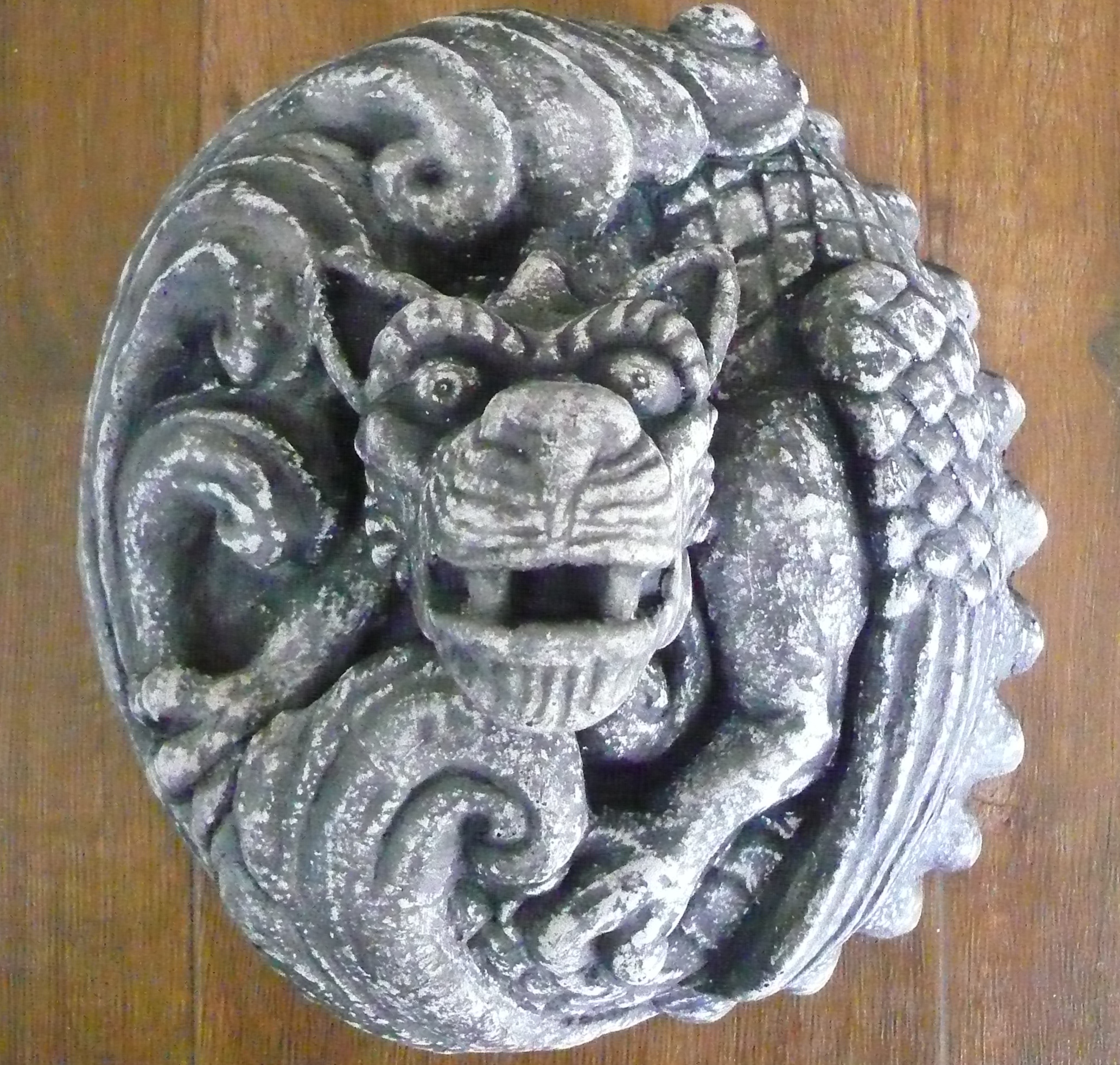
Gravely Gorgeous

P1030798

You know we are all about lovely things – sometimes ‘lovely’ is in the eye of the beholder.

This is Magz the Guardian Dragon. She’s based on a pair of dragons that guard the doors of St Margaret’s Episcopal Church in Leith, Edinburgh. And she’s made by a company called Gravely Gorgeous, which produces wall art based on gargoyles and   grotesques found in Edinburgh. They make them from jesmonite, which uses real stone to make a composite material which looks like stone and is safer than fibreglass and lighter than concrete. Jesmonite is also suitable for outdoor use – and Magz is destined for a wall in South Yorkshire (we hope she enjoys the move south of the border and doesn’t feel the need to breathe fire on anyone).

The man behind Gravely Gorgeous is Philip Obermarck, a visual artist and sculptor who was born in the US but now lives in Scotland. A lot of his work other than for Gravely Gorgeous has quite a dark aspect to it, but Magz looks quite friendly – for a dragon.

Gravely Gorgeous sells online and ships internationally.

Time to get to work

Embed from Getty Images
Can you believe January is over? No, us neither. But it’s February and that means one of two things. Either the spring sun light will soon be shining its unforgiving light through those streaky windows and onto every surface in the house; or the snow will be reflecting and intensifying the winter sun light into unforgiving beams shining through those streaky windows and onto every surface in the house. Whichever, it’s time to think about spring cleaning, because there is absolutely nothing fabulous or lovely about dirt.

On the other hand though, cleaning itself doesn’t really count as fabulous or lovely either. You probably won’t be surprised that we have some tips for getting the stuff done as quickly and efficiently as possible so that we can all get on with more interesting things. (Have you seen the lovely new homeware in Anthropologie?)

First of all, you really don’t need a massive amount of cleaning products in the cupboard, but make sure that you keep a few where they are needed. For instance, keep antibacterial wipes and bleach in each bathroom so when you see something that needs a clean, you can do it straightaway. Oh, and if you have more than one floor in your home, find a corner in a cupboard on each for a duster, polish and spare bin bags and that way you won’t waste time carrying things up and down stairs.

On the subject of cleaning products… here is a little secret. You know when you stand in front of a whole display of them and they whisper ‘Buy us! All of us! You can take us home, leave us in the cupboard under the sink and our very presence there will not only magically clean your house with no effort on your part, but also give you the key to everlasting happiness’? It’s not true. Really. You can trust us on this. You’ll only be disappointed. (Look at it this way – if it were true don’t you think we would have shared by now?) There is one gadget we love though (and it’s just the thing for those streaky windows we mentioned earlier): this baby, the Karcher Window Vac:

WV_50

It sucks up water without leaving streaks, so to clean glass all you have to do is wipe it with warm water and a drop of washing up liquid using a micro fibre cloth, then suck up the water. As well as windows, you can use it on mirrors, glass doors, glazed picture frames and tiled walls. You can buy a special cleaning concentrate and a spray bottle with a microfibre head but see above! You really don’t need them!

Now windows don’t need cleaning often, but somethings do and the best advice for those is: have a routine. Do a proper clean of each room once a week and then all it will need on the other days is a few minutes tidying up and wiping down. That way you set an easy target for each day, feel virtuous when you achieve it and – this is the important bit – still have time for other things!

However, one thing we think should be left to the professionals is oven cleaning. Whatever the latest product is, it takes ages, smells foul, involves scary chemicals and the results never seem to look really clean. Most of the oven cleaning companies operate on a franchise basis so it’s worth getting local recommendations as the service from one company to another can vary between areas.

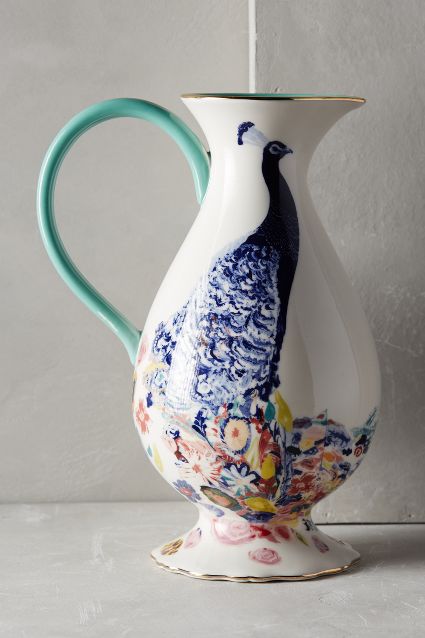
Now that’s sorted, have you seen this jug from Anthropologie? Isn’t it gorgeous?

A7543402421234_040_b

Why not smile at a crocodile?

OK, so received wisdom is against it but why not? At least when we are talking about mock-croc effect!

We got new bedroom curtains recently – well, actually before Christmas but we’ve just been too busy to talk about them until now. Here they are:

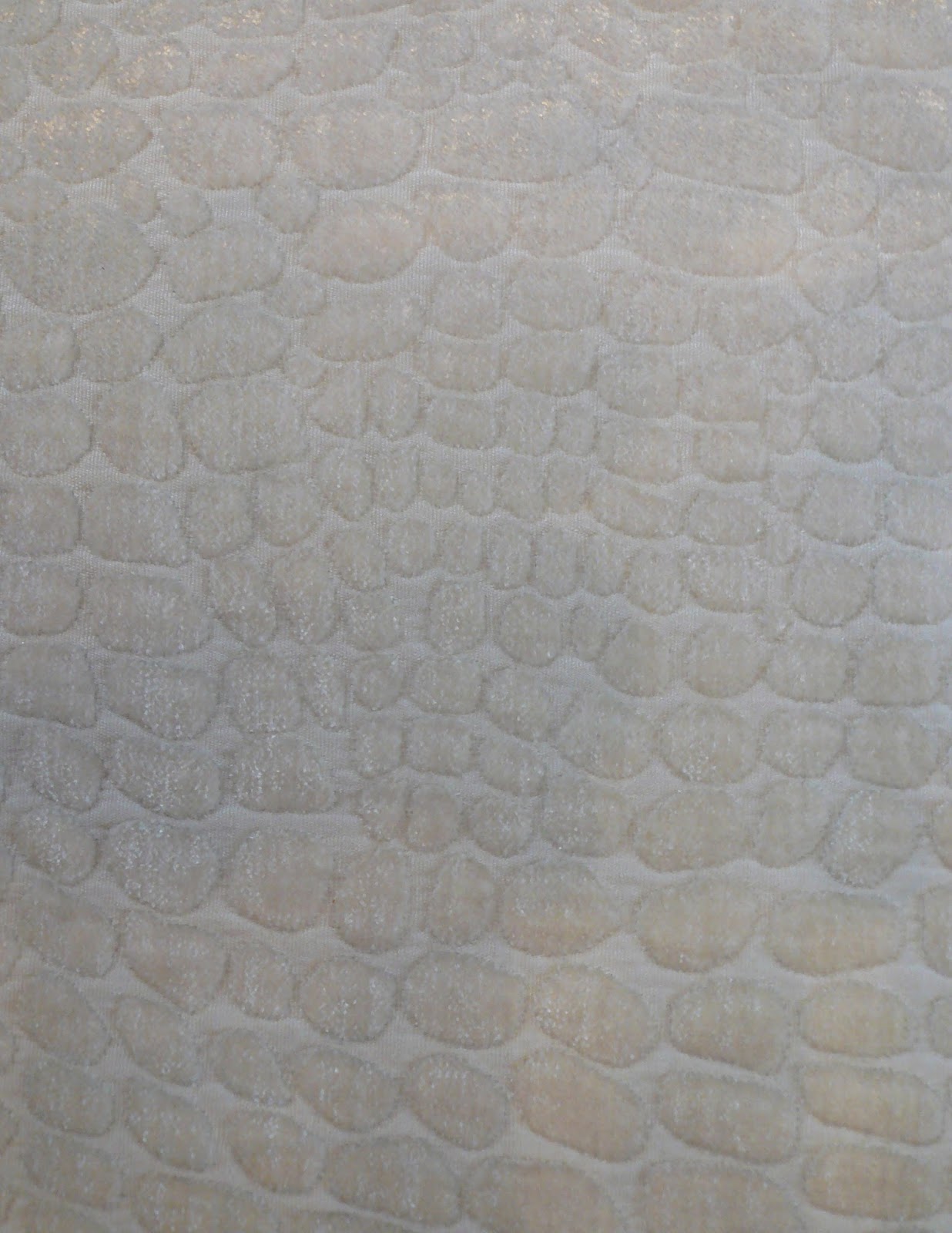
From the photo, they look like they are a plain pinky-cream fabric (it’s a combination of lighting, less than professional photography) so here is a close up which shows the pattern and the colour more accurately:
The fabric is made by a company called Fibre Naturelle Ltd. It’s called ‘Marble’ (although it is clearly a reptile skin print) from their Milano range and It comes in a range of colours – this one is ‘almondie’. 
The curtains themselves were made by a company called Cotton and Chintz and the service from them was excellent. Julie brought round loads of samples, measured the windows and then came back to fit them when the curtains were made. It was all very friendly and efficient – and the price was highly competitive too!
We like them so much that we’re beginning to regret not having these tiles in the bathroom:
They are Crocodile in white, from Topps Tiles
So we are definitely smiling at a crocodile at the moment – is it just us or is this going to be a bit of a thing this year?

The most festive, least effort, cheapest Christmas idea!

You know that as well as fabulous and lovely, we also love cheap and easy, right? Well, this has got to be the cheapest and easiest idea for the Christmas season.

Lots of magazines and web sites are packed with ideas for lovely new Christmas decorations (cobalt blue seems a popular colour for lights this year). And lots of them also have hints for revamping old decorations. One that we saw suggested decoupaging existing baubles to give them a new look. Another was to revamp them with glitter and stick-on gems. But that seems to imply that old decorations need a new look – and although we have a firm policy of ‘each to their own’, we have to offer a respectful disagreement on this one!

Christmas decorations aren’t meant to change each year. They’re not meant to be fashionable. Half the fun is getting out the old, sagging cardboard box and seeing the decorations that were carefully packed away last year, and in some cases, each year for many years before that. They come out every year and the memories come out with them. The best decorations are not the newest but the ones that were given by someone special, made by someone special or come from a special place. (Although let’s be honest, sometimes we enjoy the memory and discreetly leave the actual decoration in the box!)

So here is the most festive, least effort, cheapest Christmas idea – your old decorations are great and you don’t have to do anything to them. Not one thing. Reuse what you have and enjoy them and then do exactly the same next year! Add to them if you want of course, but don’t feel under any pressure at all (there’ll always be something else at this time of year to feel under pressure about). Your tree might not be in this year’s latest colour or design theme, but it will be original and full of things that are special to you. And we think that means it will be pretty fabulous and lovely.

Trevor Jones

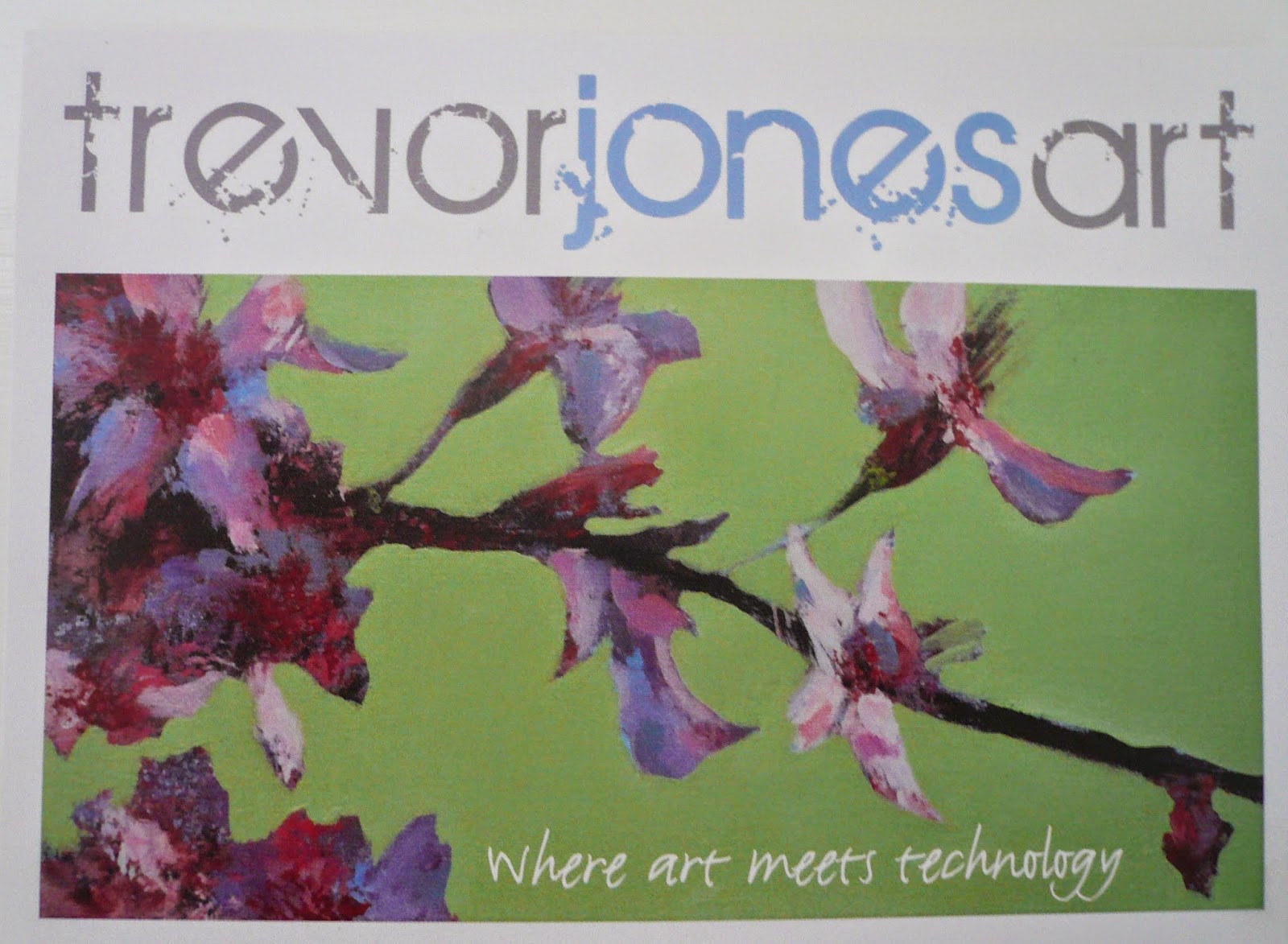
Last week, we went to the Edinburgh Art Fair, which is Scotland’s largest annual art show. One of the highlights was seeing the work of (and getting to meet) Trevor Jones, a Canadian artist who lives and works in Edinburgh and whose work combines oil painting and augmented reality. Scan a painting with a special, free, app (Junaio) and a whole other world is revealed. So, for example, scan the cherry blossoms on his business card with a phone or an iPad and a slightly unsettling walk through the Edinburgh Botanic Gardens unfolds. Scan the painting of the mechanism of the Eiffel Tower and the see in action the mechanism that takes the cars to the viewing platforms.

It’s a bit difficult to explain, but visit his website trevorjonesart.com to see the work in action. Trevor uses technology to enhance the viewer’s experience of his art, but his work isn’t technology-led. He has a degree in fine art and teaches drawing and painting at the Leith School of Art. His slogan is ‘where art meets technology’ and it is clearly art that comes first, with the technological aspect helping to explore what we really see in front of us. The paintings are beautiful in their own right rather than just being a vehicle (and check out the lovely tree drawings on the site).

So it’s exciting stuff and we are looking forward to seeing where Trevor’s art takes him. He takes commissions, so if your decor is missing a truly original artwork, he might be the man to help!

Handsome beasts

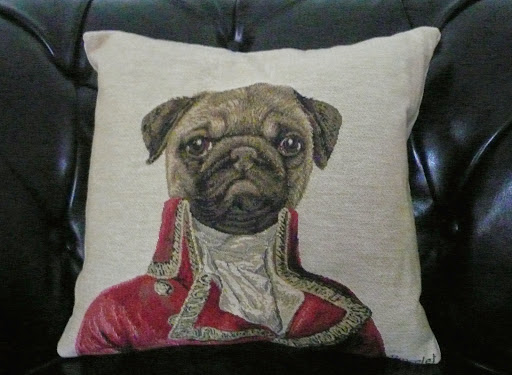
This handsome gentleman arrived yesterday:

He doesn’t look too happy, but he seems to have made himself at home on the sofa and we are delighted to have him. He’ll make several friends here, including this foxy naval officer whose hanging around:

What is it about pictures of creatures with animal heads and human bodies, often in uniform? They are undoubtedly charming and very popular at the moment – but why? Because when you think about it, it is a little curious…

We think it can all be traced back to Charlotte Cory, who is now the Artist in Residence at the Gilbert Scott Bar at the gothic St Pancras hotel. In 2007, she held an exhibition in London called ‘Charlotte Cory’s Cabinet of Curiosities’. The idea behind it was to create photographs using Victorian photographic visiting cards and stuffed animals, which she calls ‘visititorians’, so as to avoid describing them as people or animals. This led to a book ‘The Visitors’ and subsequent projects such as an exhibition at the Globe Theatre and an installation at Haworth Parsonage (home of the Brontës). She also produces furniture with some of her designs – have a look on our Pinterest board. You can see Charlotte’s work on her web site. We don’t like to gossip but apparently the Queen has two of her pictures…

In the last few years, creatures bearing the clear influence of her work have started appearing on cushions and prints all over the place, making visitorian charm available to a wider market. Evans Lichfield have some lovely cushions and our fine naval man came from Fab Funky, where there is an amazing selection of prints (and great customer service).

A moment about lightbulbs!

The clocks have gone back, Halloween has been and gone, Bonfire Night is over and the nights are getting dark and cold… a lightbulb moment!

The lack of natural light outside means it’s even more important to have good lighting  inside. There are three kinds of lighting: background lighting, lighting for specific tasks and and lighting to highlight the particularly lovely things in your home. It’s important to have good shades for all of them to look good and do their job. 
After the lightbulb moment, a moment about lightbulbs. For background lighting, there is a place for the exposed bulb look but it can be quite industrial and not the cosiest on winter evenings. Plus, a gentler light can be kinder, if you know what we’re saying. You don’t need help from good lighting, but we’ll take it happily! Have you noticed how most restaurants use ceiling lights with some kind of diffuser shade? That’s because the softer light makes everyone look better. Really. If your dining companion looks at their best, and they think that you are looking at your best (because you are so happy to be with them) and everything is lit with a warm glow, the scene is set for a great evening.
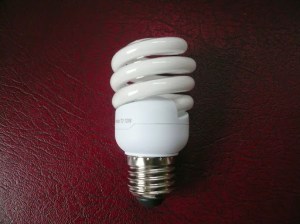
And here’s another reason for using diffuser shades. If your ambient lighting involves ceiling lights the bulb is likely to be in your sightline when you sit down. There was something quite attractive about the the old-style incandescent bulbs, but they are being phased out (they are already banned in some countries, like Mexico) and replaced with more energy-efficient but frankly unattractive ones, like this fluorescent one:
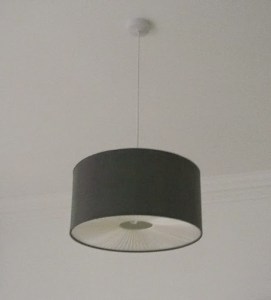
So a diffuser shade gives a softer light and hides the bulb. Here are some examples. This is the classic diffuser – a disc at the bottom of the shade so that light shines through. This one fits flush to the ceiling with the bulbs at an angle inside so that the light is directed through the sides:

This one is suspended from the ceiling and uses pleated fabric to create the diffused effect:

And this has a smaller fabric diffuser but obscures the bulb with crystal drops to give soft lighting and a bit of sparkle:

So – no need to look at those bulbs anymore. They can just go about their job making us look fabulous in secret!

Blinding!

At least one good thing about the nights getting longer is that we get to pull the blinds and curtains and make the house cosy! Time to think about window treatments.

So, what to do about a big window – actually a trifold door – in the kitchen? Firstly, we didn’t want curtains. Fabric in the kitchen collects smells and dirt like any other surface so needs to be washed/cleaned frequently and frankly, with a big window that could be a lot of work. So we had a look at blinds.

With horizontal blinds, the mechanics are the problem. The window is to big to have a single horizontal blind, so would need several next to each other. But then what about the gap between them? And what about the hanging cords or rods? So that led us to think about vertical blinds.

There are really two kinds of vertical blinds: ones that are fixed top and bottom and ones that are made up of panels suspended from the ceiling. We didn’t want ones that were fixed at the bottom because we thought that when the blinds were drawn and the door was open, a track on the floor would be a trip hazard. So by now, we had narrowed it down to vertical panel blinds suspended from the ceiling. They can be mounted on a multiple track rail, which means individual panels can overlap and there is no gap where they butt up against each other. There’s one cord to operate all of them and it is hidden away at the side.

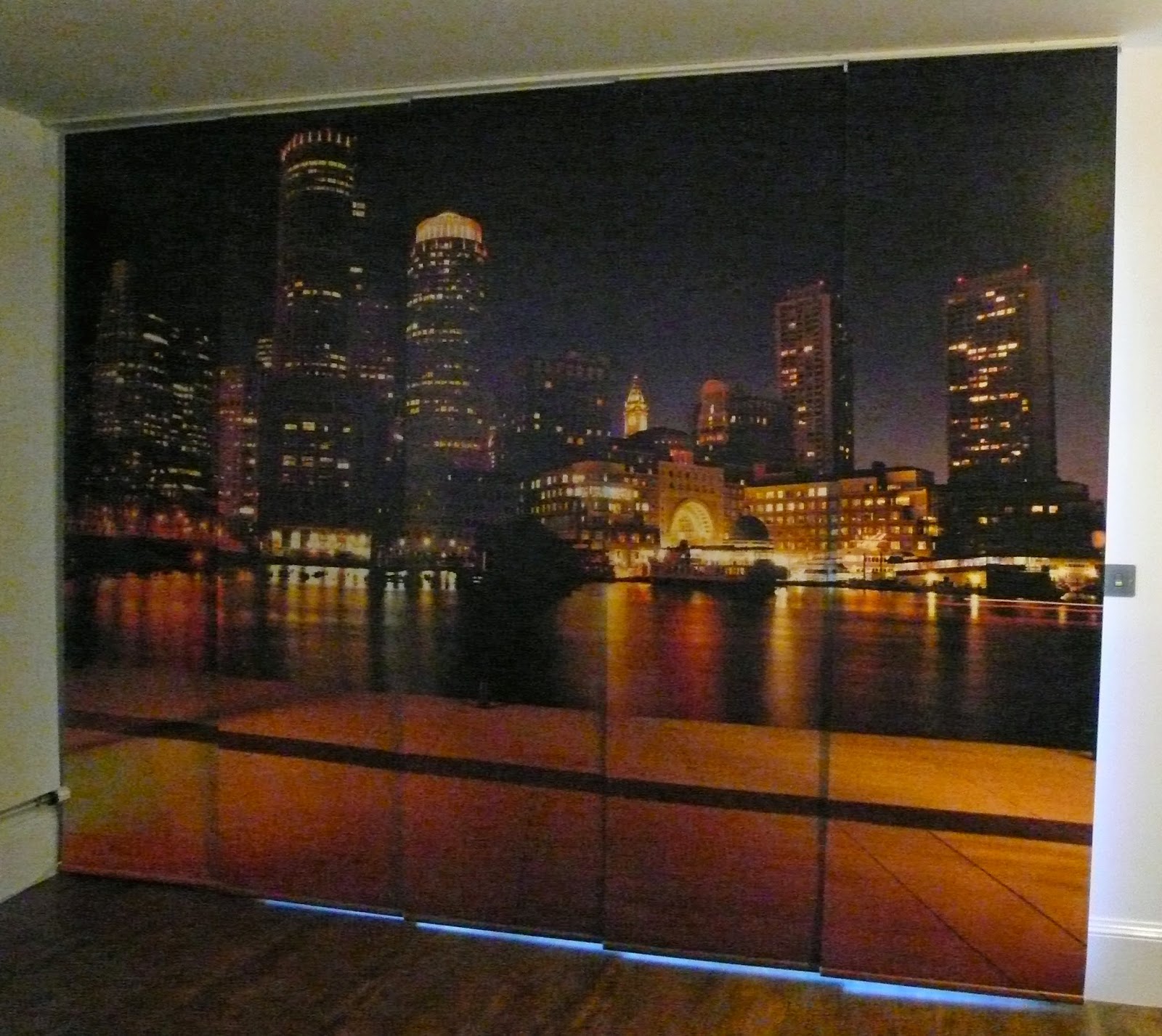
And at that we were just expecting to look at some sample books and pick out a suitable vinyl fabric, but after a chat with the lovely people at Albany Blinds Edinburgh we realised there was another, much more fun option. They can print just about anything on to a panel blind. So you can choose any professional quality image and they can print it! 
Now we know you’re too kind to mention it, but our photography is a long way from professional quality so whilst the idea of a favourite holiday snap on the blind was initially appealing, it didn’t take too long to realise that it wasn’t a good idea! Fortunately, there are whole libraries of beautiful, professional photos and images and for an appropriate (but not expensive) fee, you can buy the right to use them.  Two of the best are Getty Images and Shutterstock
So we asked ourselves: what would be a great view from a window? It has to be a nighttime view, because the blinds will only be drawn at night and a daytime view would be a bit odd. Nighttime in the country or at the beach is just, well, dark. The only thing that would really show up at night is a cityscape – and remember how great the view from Frasier Crane’s apartment looked? 
Now we just have to pull the blinds and we’re in Boston! 
Albany Blinds Edinburgh provided a great service and couldn’t have been more helpful.

Happy teardrops

We heard about this the other day – a very cool concept caravan holiday home with sliding internal doors so that the space is flexible enough to provide bedrooms, dining space, a relaxing area or a cinema for 9! (We know: a cool concept caravan – guess you just never know what you are going to type one day…)

The idea is based on Japanese design and the idea that walls can be moved to change the internal configuration of a space for different occasions. As you can see, the design is as far from the traditional, dark and old fashioned caravan as you could want.

But do you know what? Even though we are not people to whom the idea of camping comes naturally, it just made us remember that we have always really wanted one of these: a retro teardrop trailer.


A teardrop is usually 4 feet by 8 feet and the main body is a sleeping area. Cooking is done outside the trailer from a galley concealed in a lift-up hatch at the back. (This gorgeous picture is from a website called oldwoodies.com which has lots of pictures of and information about wooden framed body vehicles.) Just enough room for two. So really the other end of the spectrum from a cinema room for 9, but still a beautiful design.